
Oceana Projected and Actual Release
A projected date is a calculation or eligibility point, not proof that the person walked out. For an MDOC prisoner, the public field commonly called the Earliest Release Date marks when the Michigan Parole Board may first have jurisdiction to consider release. The Board may grant, deny, or defer action under the governing law. Even a grant can precede the day the person leaves prison. “Date Paroled” is a stronger field for actual departure on parole, while “Maximum Discharge Date” describes the potential sentence end under the displayed calculation.
County custody works differently. A pretrial detainee at the Oceana County Jail is awaiting case action and ordinarily has no sentenced release date. Bond, dismissal, a plea, a court order, or transfer can change custody. A person serving a county sentence may have a jail calculation based on the judgment, jail credit, and the county good-behavior rule. The county inmate-information page supplies the local jail contact and current-person route. None of those local records belongs in OTIS unless MDOC jurisdiction is also involved.
| Date or event | Meaning | Does it prove departure? |
|---|---|---|
| Earliest Release Date | First parole-consideration point shown for the MDOC sentence | No |
| Parole grant | Board approval subject to the case and later release processing | No |
| Date Paroled | OTIS field tied to actual departure from prison on parole | Strong public evidence |
| Maximum Discharge Date | Potential maximum sentence end under the calculation | No |
| Jail release event | County record of release, transfer, or other exit | Only if the event says community release |
Find an Oceana Projected Release Date
Start with the source that holds the sentence. The Michigan Department of Corrections OTIS portal is for prisoners, parolees, probationers, and recent MDOC discharges within its stated scope. It expressly excludes people held only in county jail. The Oceana County Jail and the sentencing court are therefore the right sources for a county term. The full Oceana County released inmate search helps identify the custody route when that part is still unclear.
- Determine whether the person is pretrial, serving an Oceana County jail sentence, or committed to MDOC. Read the judgment and current agency record.
- For MDOC custody, search OTIS by MDOC number or exact name. Compare identity, sentencing county, court, offense, and sentence fields.
- Read “Earliest Release Date,” “Maximum Discharge Date,” current status, and “Date Paroled” when shown. Do not substitute one label for another.
- For an Oceana County jail sentence, obtain the judgment, jail-credit language, and the jail’s actual calculation. Call the jail at (231) 873-3967 when direct confirmation is needed.
- For a pretrial case, check MiCOURT for bond and court events. Do not calculate earned time before a sentence exists.
- When the expected date changes, compare amended judgments, consecutive terms, detainers, discipline, and Parole Board action before asking the source agency to correct a record.
A court register can explain the legal basis for a change, but it may not show the minute jail staff completed the release. Pair it with a jail or MDOC custody event. A transfer record means the person changed custodians and may still be confined.
Oceana County uses two local criminal courts for this path. The 79th District Court handles misdemeanors, arraignments, and preliminary felony events. The 51st Circuit Court handles felony disposition and sentencing. Select the correct court in MiCOURT and read the register for bond, plea, dismissal, sentencing, jail credit, probation, commitment, and amended orders. Circuit online criminal name access is limited to cases filed in 2018 and later. For an older nonsealed record, contact the clerk instead of treating a missing name as proof that no sentence exists.
Oceana Release Dates in OTIS
OTIS uses precise labels. Its explanation calls the parole-board jurisdiction date the prisoner’s earliest release date, or ERD. That is when the Board can first consider release in the case described. The maximum date is the potential maximum end of the sentence. For a parolee, “Date Paroled” provides the clearest public field for when the person actually left prison. A probation profile can use an release-related date for the supervision term, so the current status must be read with the sentence type.
Open a profile only after matching the MDOC number, SID number, name, aliases, physical descriptors, sentencing county, court, and sentence. The record can also show current status, active and inactive sentences, minimum and maximum terms, discharge data, supervision information, and an MDOC image. It does not document a county-jail-only stay. OTIS also omits people discharged from MDOC supervision more than three years ago and information excluded from public access.
The official OTIS landing page states the locator’s state-corrections scope and exclusions.
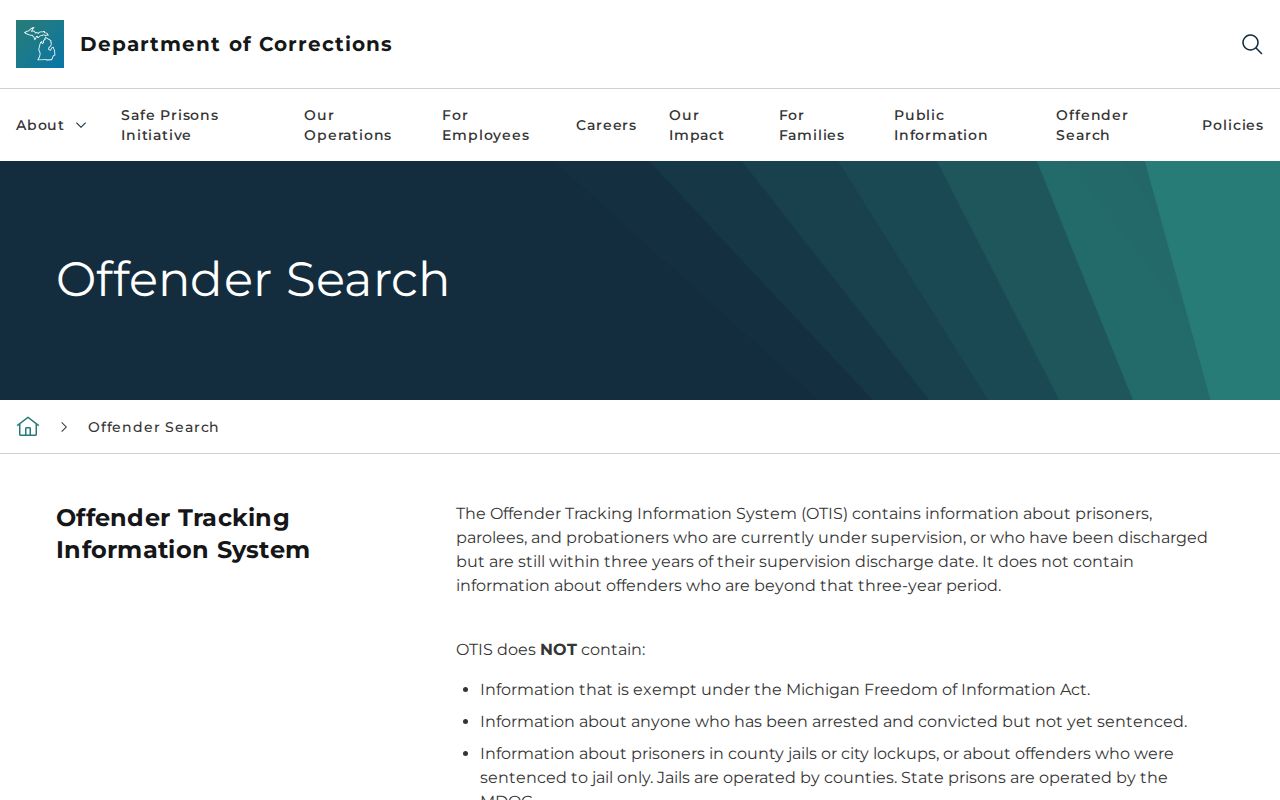
The captured source is the correct starting point for an MDOC sentence, not for a person whose custody never moved beyond Oceana County Jail.
If the profile looks wrong, follow the source of the field. MDOC says most OTIS sentence information comes from court records, so a mistaken sentence, county, or judgment item should be raised with the sentencing court. A current parole or probation status error belongs with the assigned supervision office. MDOC lists correctionsinfo@michigan.gov for general accuracy questions and mdocwebmaster@michigan.gov for technical issues. A correction request is not itself proof that the displayed release date is wrong.
Note: The ERD is a parole-consideration point, while Date Paroled is evidence of actual prison departure.
Oceana State Release Date Rules
Michigan’s modern Truth in Sentencing framework does not use a generic 85-percent rule. The MDOC explanation says affected prisoners must serve the full judicial minimum before parole consideration. The rule applies to specified assaultive offenses committed on or after December 15, 1998, and all other offenses committed on or after December 15, 2000. Good time or disciplinary credits do not shorten that minimum for those sentences.
Older sentences may be credit-eligible, so the offense date and statute matter. Under MCL 791.234, a credit-eligible prisoner may come under Board jurisdiction after the minimum less applicable credits, while a disciplinary-time prisoner must serve the whole minimum. Consecutive terms can aggregate the minimum and maximum. MCL 791.233 still leaves the parole decision to the Board, so reaching jurisdiction is not an order of release.
Disciplinary time for major misconduct can affect the Board’s review under Michigan law, but that is not the same calculation as county-jail good time. The state sentence must be analyzed by offense date and applicable credit regime. A simple percentage estimate can obscure the judicial minimum, consecutive terms, and the Parole Board’s discretion. OTIS supplies the public date fields, while the judgment and statute explain how the sentence was built.
- ERD
- Earliest Release Date, the point at which parole consideration may begin for the displayed sentence.
- Judicial minimum
- The minimum term imposed by the court before parole rules are applied.
- Maximum discharge
- The potential end of the sentence under the current calculation.
- Detainer
- A request or hold from another authority that can prevent community release.
Two Oceana Release Credit Regimes
Oceana County cases can involve two credit regimes that must not be blended. A modern truth-in-sentencing state prisoner generally serves the full judicial minimum before parole consideration. A rule-compliant person serving a sentence in the county jail receives the separate one-for-six reduction set by Michigan’s county-jail statute. The place of custody and sentence type determine which rule applies.
County-jail good time is a separate Michigan rule. MCL 51.282 gives a sentenced jail prisoner one day of reduction for each six days of sentence when the record shows no rule violations. The sheriff’s rules control forfeiture for infractions, and the sheriff can restore certain lost time. MCL 51.283 requires the rules and allowance to be posted and places a duty on an eligible prisoner to bring the entitlement to the sheriff’s attention.
Do not apply the one-for-six calculation to an MDOC earliest release date. For an Oceana jail sentence, request the judgment, all jail-credit terms, and the jail’s actual calculation. Time already served before sentencing can affect the base, and an amended judgment can change it. The local jail record is stronger than an outside estimate because staff apply the sentence and custody facts held by the county.
No official Michigan statute was found that automatically moves an Oceana County jail release set for Sunday or a holiday to the prior Friday. Oceana County publishes no weekend rule. The responsible response is to confirm the processing date with the jail, not borrow a practice from another state or county.
Why Oceana Release Dates Change
A projected date can move because the inputs or legal status changed. Some changes affect the sentence calculation. Others prevent a planned community release even when the sentence date itself remains the same. Read the latest judgment, agency status, and hold information together.
| Change | Effect on the date | Best source |
|---|---|---|
| Corrected jail credit | Changes the time credited toward a county or state term | Amended judgment and custody calculation |
| Consecutive sentences | Can combine minimum and maximum terms | Judgment and OTIS sentence blocks |
| Misconduct | May affect county good time or eligible older state credits | Custodial agency record |
| Parole denial or deferral | Leaves the person confined beyond the first eligibility point | Parole Board action and later OTIS status |
| Detainer or new case | Can block community release or move the person to another custodian | Holding agency and court record |
| Amended court order | Can change sentence terms, jail credit, or release authority | Sentencing court |
An apparent change may also be a data correction. MDOC says most OTIS sentence information comes from courts. A court-data error should go to the sentencing court, while a supervision-status issue should go to the assigned MDOC field office.
Confirm an Oceana Release Date
Use a timely alert and a durable record for different functions. MI-VINE can report a county-jail or state custody event, but its update depends on the contributing agency. Registration steps and limits are detailed on the Oceana County VINE inmate check. For the permanent result, obtain the release entry from the jail or the relevant MDOC record.
For an Oceana County Jail sentence, ask whether the date reflects bond, completion, a court order, or transfer. For MDOC, compare the earliest release date, Parole Board action, current status, and Date Paroled. A transfer to MDOC, another county, federal custody, or immigration custody is not a community release. If a precise date controls a court process or personal plan, confirm it with the office that created the record.
Keep the date in context after release. Parole allows a person to leave prison while the sentence continues under MDOC supervision. Final discharge occurs later. A person may therefore have a Date Paroled, a current parole status, and a future maximum discharge date in the same profile without any conflict. For a completed county term, the jail release entry and court register perform the parallel roles. They establish the custody event and the legal basis without turning a state eligibility field into a county calculation.