
Oceana County Release Mugshots
A booking photograph records a person’s appearance during one jail admission. It is part of the arrest and booking file, not the release event itself. The official Oceana County Jail page does not provide a past-booking photo gallery. The jail release record may separately identify the booking number, release date and time, release authority, and transfer destination. Those fields matter because an old photo can remain unchanged while custody status changes many times.
Michigan law does not make every booking photograph available in every setting. The state Attorney General’s FOIA Handbook discusses a Michigan appellate decision that supported access to certain felony booking photos, while also explaining that a photograph can be withheld when the facts fit a valid exemption. Oceana County may redact protected content or deny a specific image with a written legal basis. The sound approach is to request the named booking image and the related release entry, then read the county’s response.
Oceana County Mugshot Channels
The Oceana County inmate-information route was not found to offer a public booking-photo roster or recent-release gallery. That makes source selection more important. A county booking photo, an MDOC correctional image, and a registry photo may depict the same person at different times, yet each belongs to a different record system. The table shows what the researched channels can and cannot establish.
| Channel | Has a photo? | How to access it |
|---|---|---|
| Oceana Sheriff website | No public photo gallery found | Use the county FOIA route for a named booking image. |
| Sheriff mobile app | Not promised | The official materials advertise current-inmate information and bond amounts, but not photos or a historical archive. |
| Oceana County FOIA | Available by request when public | Identify one person and booking, and ask for electronic delivery of the associated photograph. |
| MDOC OTIS | Often, but not always | Search a person who entered state jurisdiction and check the image date. |
| MI-VINE | May appear in some agency records | Search a named person. Oceana does not promise a photo or archive period. |
| Michigan registry | For published registrants | Use only when the person has a registration duty. It is not a general release list. |
| News or official press material | Sometimes | Check the article date and verify custody through the originating agency. |
| Commercial publishers | Images may persist | They are not official, are not linked here, and should not be treated as current proof. |
For a person held only at the county jail, OTIS is usually the wrong first source. OTIS excludes jail-only cases. For a person transferred into MDOC custody, its image is a state corrections image and may not match the photograph made during the Oceana booking. A MI-VINE result can help identify a custody event, but it is an alert and status service rather than a permanent photo archive.
Note: Match the image date and agency before deciding that two photographs belong to the same custody event.
Oceana Sheriff App Photo Limits
The official “Oceana County Sheriff, MI” mobile app launched as a local information channel. County sources identify Craig Mast as sheriff. The app’s published launch material says it includes current-inmate information and bond amounts. Neither the launch account nor the store description promises mugshots, a recent-release feed, or a photo archive. A reader should not assume the app has a booking picture merely because another sheriff app does.
The official Apple App Store listing shows the app’s publisher and advertised functions:
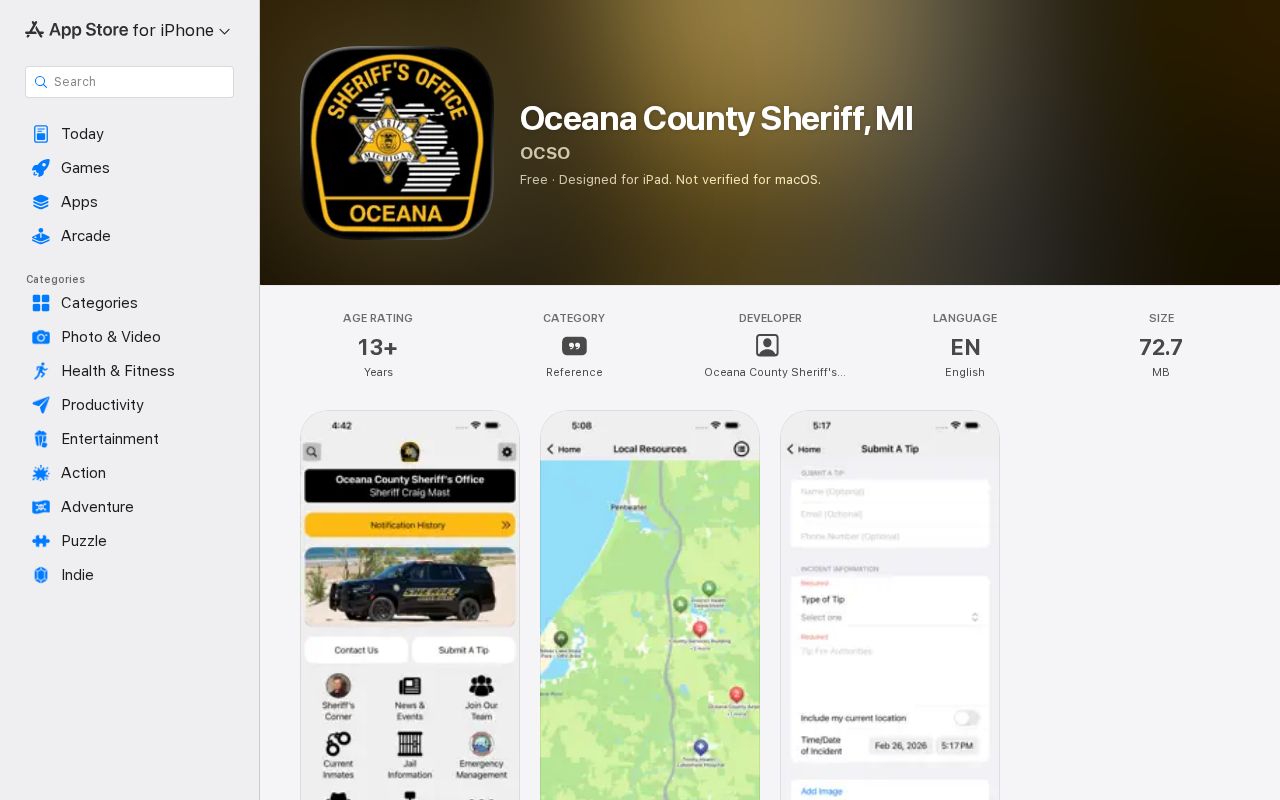
This listing supports use of the app as a current-custody cross-check. It does not support a claim that released-inmate photos will appear. If the live app shows an image for a current person, save the agency name and record details, then request the matching booking and release records from Oceana County. Once the person drops from a current view, the app still should not be treated as a historical source.
Request Oceana County Booking Photos
A narrow written request is the most direct official route to an Oceana County Jail booking photograph. The Oceana County FOIA page provides the current form, public summary, procedures, and fee policy. A requester does not have to use the form, but the description must be clear enough for county staff to locate the existing record. Put “FOIA Request” in the subject line or on the first page.
- Identify the person by full name and add any known name variant.
- Give the approximate booking date or a narrow date range. Include the case or booking number when known.
- Ask for the booking photograph tied to that specific stay. Request the booking sheet or jail-register entry as a matching reference.
- Also request the release date and time, release authority or type, and destination or receiving agency if the stay ended in transfer.
- Ask for an electronic copy. Request an itemized estimate before chargeable work and offer to narrow the request.
- If a portion is exempt, ask the county to redact that part and provide the nonexempt remainder.
The Michigan FOIA response period is generally five business days. The county may grant, deny, grant in part, or issue one extension notice for up to ten more business days. That is a response rule, not a promise that every image will arrive within five days. Fees can include permitted labor, copying, media, and mailing costs under MCL 15.234. Oceana does not publish a flat booking-photo price, so no fixed amount should be assumed.
The county FOIA Coordinator receives mail through the County Administrator’s Office at 100 S. State Street, Suite M-4, Hart, MI 49420. The published phone is (231) 873-4835, and the fax is (231) 873-5914. Use the live county page for the current electronic route because staff names and addresses can change.
Oceana County MDOC Photos
The Michigan Department of Corrections OTIS search can display an offender image and image date for people within MDOC’s scope. That includes current prisoners, parolees, probationers under MDOC supervision, and people discharged from that supervision within the system’s recent discharge window. It excludes people sentenced only to the Oceana County Jail. Some profiles also lack an image because none was taken or the person left before electronic images were available.
Search by MDOC number when possible. A name search can return similar names, aliases, and spelling variants. Open the profile and compare the MDOC and SID numbers, physical descriptors, sentencing court, county, offense, and status. Then read the image date. A current status of “Discharged” means the person is no longer under MDOC supervision for the listed sentence. It does not turn the state image into the photograph from an earlier Oceana County booking.
MI-VINE and the Michigan Public Sex Offender Registry have still narrower roles. VINE may receive an agency-supplied image, but Oceana publishes no promise about one. The registry displays photos for qualifying registrants only. Registry presence is not evidence of a recent jail release, and most released people have no registration duty. For a jail-only booking photo, the county request remains the reliable path.
Oceana County Photo Record Limits
A sheriff notice or news report may reproduce an image connected with one incident. Such a photo can help identify the event, but it is not a live custody record. Publication may predate a bond decision, dismissal, transfer, sentence, or release by months or years. Check the date, caption, credited agency, and case before connecting it to the person’s current status.
Commercial mugshot publishers and broad data collections can keep copied images after an official current record changes. They are not authoritative release sources. No commercial publisher is linked or endorsed here. A demand for payment does not prove that the publisher controls the official county image or can change the source record. Questions about the government-held photograph belong with Oceana County; questions about court access belong with the court that holds the case.
Use two records when the difference matters. The booking photograph identifies the image tied to a stay. The jail release entry shows how that stay ended. MiCOURT may then explain whether bond, dismissal, sentencing, an amended order, or a transfer was the legal cause. A court register can survive after the current jail entry disappears, but it may not state the exact time staff completed the physical exit.
Set-Aside Effects on Oceana Mugshots
Michigan’s set-aside process can change public access to a conviction and related search results. A set-aside is a legal restriction on access to a qualifying conviction record. It is not the same as proving that the booking never occurred. MDOC says OTIS removes information when a sentencing court sets aside or expunges the conviction, or when removal occurs by operation of law.
Manual waiting periods under MCL 780.621d are measured from the latest applicable milestone in the statute. Depending on the case, that point can include release from imprisonment, completion of probation, or discharge from parole. Automatic set-aside rules have separate conditions, time periods, caps, and exclusions. A missing old MiCOURT or OTIS result may therefore reflect a lawful access change, a portal limit, or a name mismatch. It should not be rebuilt from cached copies.
Start correction work with the office that created the disputed record. A wrong court disposition goes to the sentencing court. A county booking-image request or response goes to the Oceana County FOIA Coordinator. An OTIS display based on corrected court data can be addressed with MDOC after the court enters the proper order. Independently held news images do not all vanish automatically, and no removal service should be treated as a substitute for the official legal process.
Note: A removed public search result may reflect lawful access limits, not proof that the earlier custody event did not occur.
Michigan Mugshot Access in Oceana
The most useful Michigan rule is precise rather than absolute. The Michigan Attorney General FOIA Handbook cites precedent supporting access to certain felony booking photographs. It also recognizes that records may be withheld when a valid exemption fits the facts. Juvenile information, victim identifiers, health data, security material, active-investigation details, sealed records, and set-aside matters may require redaction or restricted access.
No enacted Michigan law aimed specifically at commercial “pay to remove” mugshot publication was found in the official source sweep. That limited finding does not approve commercial publication and does not decide whether other privacy, defamation, sealing, copyright, or court rules apply. It simply means the official research did not locate that state-specific enactment.
For an Oceana County image, request one named photograph and the related release event. Keep the county’s written response. If access is denied, review the cited exemption and the appeal information supplied under FOIA. This process preserves the key distinction: the photograph documents a booking, while the release record and court order explain what happened after it.
Note: Request the release event with the photograph so an old image is not mistaken for a current custody record.