
Oceana Parole and Probation Compared
Parole and probation can both place a person under rules while living outside a jail or prison, but they begin in different ways. Michigan law describes parole as permission to leave prison while the person continues to serve the sentence. It is not final discharge. Probation is a sentence imposed by a court and served in the community, sometimes after a short county-jail term. In Oceana County, felony parole and probation under state jurisdiction are handled through the Michigan Department of Corrections Field Operations Administration. District-court probation is a court function and should not be confused with the MDOC field office.
The distinction controls where a record appears. OTIS covers people under MDOC parole or probation supervision and people discharged from that supervision within its stated three-year window. It excludes a person whose only sentence was in a county jail. The 79th District Court record may instead document local probation. Absence from the Oceana County Jail lookup proves neither status.
| Feature | Parole | Probation |
|---|---|---|
| How it begins | Release from an MDOC prison under a parole order | A sentence or order entered by a court |
| Custody meaning | The prison term continues in the community | The person serves a community sentence, with or without a jail component |
| Primary public check | OTIS status and MDOC field office | OTIS for MDOC felony probation; MiCOURT for the court order |
| End point | Discharge, revocation, or another lawful status change | Discharge, court action, violation outcome, or completion |
- Parole
- Conditional permission to leave state prison while the sentence remains active.
- Probation
- A court-ordered community sentence with stated duties and limits.
- Discharge
- The formal end of the supervision term or sentence status at issue.
- Absconder
- A person the supervising agency says has stopped reporting or has eluded supervision.
Verify Oceana Post-Release Supervision
Begin with the custody system that imposed supervision. A former state prisoner or a person on MDOC felony probation may appear in OTIS. A county-jail-only sentence will not. Matching the correct person matters because names and aliases can overlap. Use the MDOC number when it is known, then compare the name, physical descriptors, sentencing county, court, and sentence details. The released-person search and release-record path on the Oceana County released inmates page can help when the first task is determining which agency held the person.
- Search OTIS by exact name or MDOC number. Review all plausible matches instead of choosing the first similar name.
- Open the profile and read the current status. “Parolee,” “probationer,” “discharged,” and “absconder” do not mean the same thing.
- Check active and inactive sentence blocks, the sentencing county, and any supervision location shown in the record.
- Use MiCOURT Case Search to find the sentencing order or later probation orders. Select the correct Oceana court.
- Contact the Oceana County Parole/Probation Office when the status needs direct confirmation or a supervision field appears wrong.
- For proof that supervision ended, ask the proper office about a discharge certificate or certified record rather than relying on a screen alone.
OTIS is the stronger public source for current MDOC supervision status. The court register is stronger for what the judge ordered. Neither should be treated as a live location tracker. When the records conflict, the source of the disputed item controls the correction route. MDOC says court-data errors should go to the sentencing court, while a supervision error should go to the assigned field office.
Use Oceana County’s court split correctly. The 79th District Court handles misdemeanors, preliminary felony events, and district probation. The 51st Circuit Court handles felony disposition and sentencing. A later register entry may show a probation order, violation hearing, amended judgment, or discharge. It explains the court action but may not reflect the newest MDOC field update, so compare the date and authority of each record.
Note: A person may be outside prison yet remain under MDOC authority until parole is formally discharged.
Oceana Supervision Office Details
Oceana County has a combined MDOC Parole/Probation Office in Hart. It belongs to Region 4a, which also covers Lake, Mason, Mecosta, Newaygo, and Osceola counties. The office can address an MDOC supervision assignment, a suspected profile error, and the correct agent or office route when public information is not enough. It is not the 79th District Court probation office, the county jail, or the Parole Board.
Oceana County Parole/Probation Office
844 S. Griswold Street, Suite 600
Hart, MI 49420-1227
Phone: (231) 873-4776
The official directory supplies the address and phone but does not state public walk-in hours. Call first if an in-person visit is needed. A request about district probation should go to the court named in the case, not to this field office.
The MDOC Region 4 directory shows the local listing and office context.
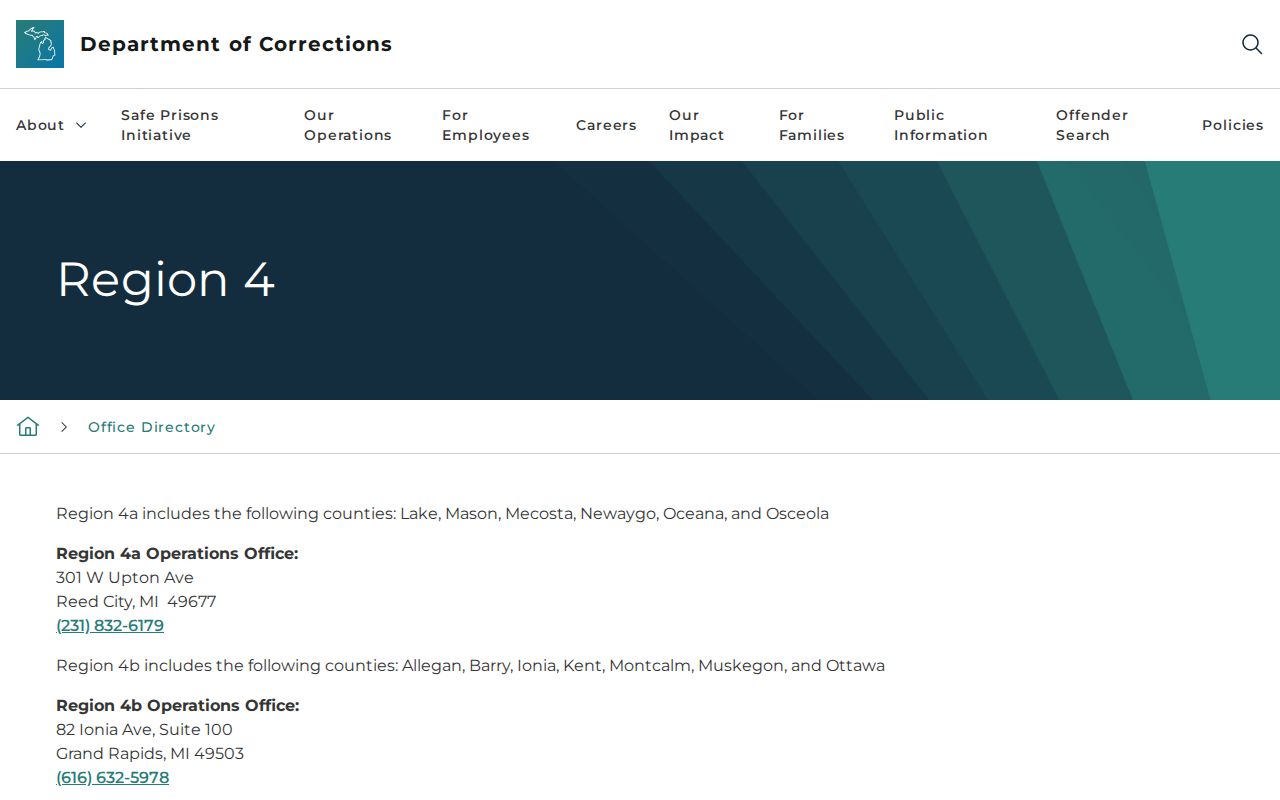
The captured directory is useful for confirming that the Hart office is the state parole and probation contact for Oceana County.
Oceana Parole Hearing Records
The Michigan Parole Board is the sole paroling authority for felony prisoners committed to MDOC. Reaching the earliest release date means the Board can consider parole. It does not force a grant or prove a physical release. Most decisions use three-member panels, while life cases follow the applicable full-board process. A grant can still precede the actual date the person leaves prison.
The public-hearing registration hub is not a full calendar of every routine parole interview. It posts person-specific lifer-law, commutation, and pardon hearings, often about two weeks to 30 days ahead. Public attendees generally must register at least two business days before the hearing. Recording, photos, and screenshots of the hearing are barred. No public, person-by-person decision database was found. OTIS may later show “Date Paroled” and the resulting status, while an exact order may require contact with the Board or a proper records request.
Oceana Supervision Warrants and Absconders
An absconder label is not a successful end to supervision. It means MDOC reports that the person stopped reporting or otherwise eluded supervision. A warrant can also remain active after a person has physically left custody. The court or sheriff should confirm a specific warrant because no official searchable Oceana County warrant-name list was found. MDOC lists an Absconder/Escapee Tip Line at (517) 755-0855 for location information about a parole absconder.
A February 2025 county board packet recorded a sheriff’s estimate of about 800 outstanding warrants, some years old. That figure is a dated meeting snapshot, not a live count. It should not be used to infer anything about a named person. Search the case in MiCOURT, note the court and case number, and seek direct confirmation. An OTIS absconder status concerns MDOC supervision; a local bench warrant may arise from a separate court event.
Note: Physical release, active supervision, and warrant status are separate facts that may coexist in one case.
Oceana Release Programs and Reentry
The Oceana County Jail inmate-information page lists GED work, West Michigan Community Mental Health, Jail Ministry, Bible study, anger management, and substance-use programming with an after-release aim. Those programs may help someone prepare to return to the community. They are still in-jail programs. The county does not identify them as a separate reentry office, halfway house, or guaranteed post-release placement.
That boundary matters when verifying post-release supervision. A program contact does not replace the assigned agent, court order, or MDOC status record. Ask the supervising office which services or reporting steps apply to the person’s actual order. Conditions may address reporting, travel, treatment, testing, fees, or contact limits, but a public summary cannot establish the terms of an individual case. The signed order and supervising agency remain controlling.
Property After an Oceana Release
Oceana County’s corrections-officer description says jail staff inventory and safeguard clothing, money, and belongings, then return them at release. The county does not publish an unclaimed-property schedule. If something is missing, contact the Oceana County Sheriff’s Office and identify the booking. Ask for the property inventory and release receipt when those records are needed to trace the item.
This property step is separate from parole or probation. An MDOC agent does not become the custodian of belongings left at the county jail. A transfer also changes the route because property may travel with the person or be handled under the receiving agency’s rules. Confirm whether the event was a community release or a transfer before deciding which office holds the record.
Oceana Supervision and Final Discharge
Supervision can end through successful discharge, revocation and return, a court order, or another lawful status change. Completion of parole is not the same event as the day a person first leaves prison. MCL 791.238 treats a parolee as still serving the sentence. For probation, the court order and MDOC status must be read in context because the supervising authority depends on the case.
A discharged OTIS profile can remain public within MDOC’s three-year discharge window, unless a set-aside or operation of law changes access sooner. If the public profile is not enough, ask about the discharge certificate. MDOC also describes a certified records package called a PENPACK for paroled or discharged people, though restricted parts are not promised to every requester. Keep a copy of the court order, the public status, and any certificate because OTIS is not a permanent archive.